Leadership practitioner & writer

Ratish
Kumar

Twenty years of leading teams across banking, IT services, US healthcare, e-governance, and CRM technology. Writing now on the practice of leadership and the governance of the systems that increasingly shape it.

Mumbai, India Creator of the BUILD+ Leadership Framework

Writing

Two works, currently in development.

A practical guide for first-time leaders, and a working paper on the governance of AI accountability. Different subjects. Same underlying interest: what it actually takes to lead well when the work is consequential and the human stakes are real.

Forthcoming Book

BUILD+

A Practical Guide for First-Time Leaders

Every year, thousands of capable people get promoted into leadership roles. And almost none of them are really prepared for what the job actually asks of them.

Not the operational part. There are templates and onboarding decks for that. The mechanics get covered. It is the human part no one prepares you for. The moment your authority stops being enough. The moment your intelligence stops being the thing that sets you apart. The slow realization that the skills which got you here are not the skills that will help you grow into the role.

BUILD+ is written for that moment, and for the three years that follow it. At its heart is the framework I call BUILD+. The framework has two halves, and the argument of the book is that they belong together. The BUILD half is structural — five pillars answering what a leader should do. The + half is human — seven chapters answering how a leader should show up. Three things run underneath both: emotional intelligence, respect, and a shared vision strong enough to outlast any single person who holds the role.

The book carries seven real moments from my own career — placed at the chapters where their lessons land hardest. It closes with a diagnostic across eight observable dimensions, so a reader can see where they actually stand and where to focus next.
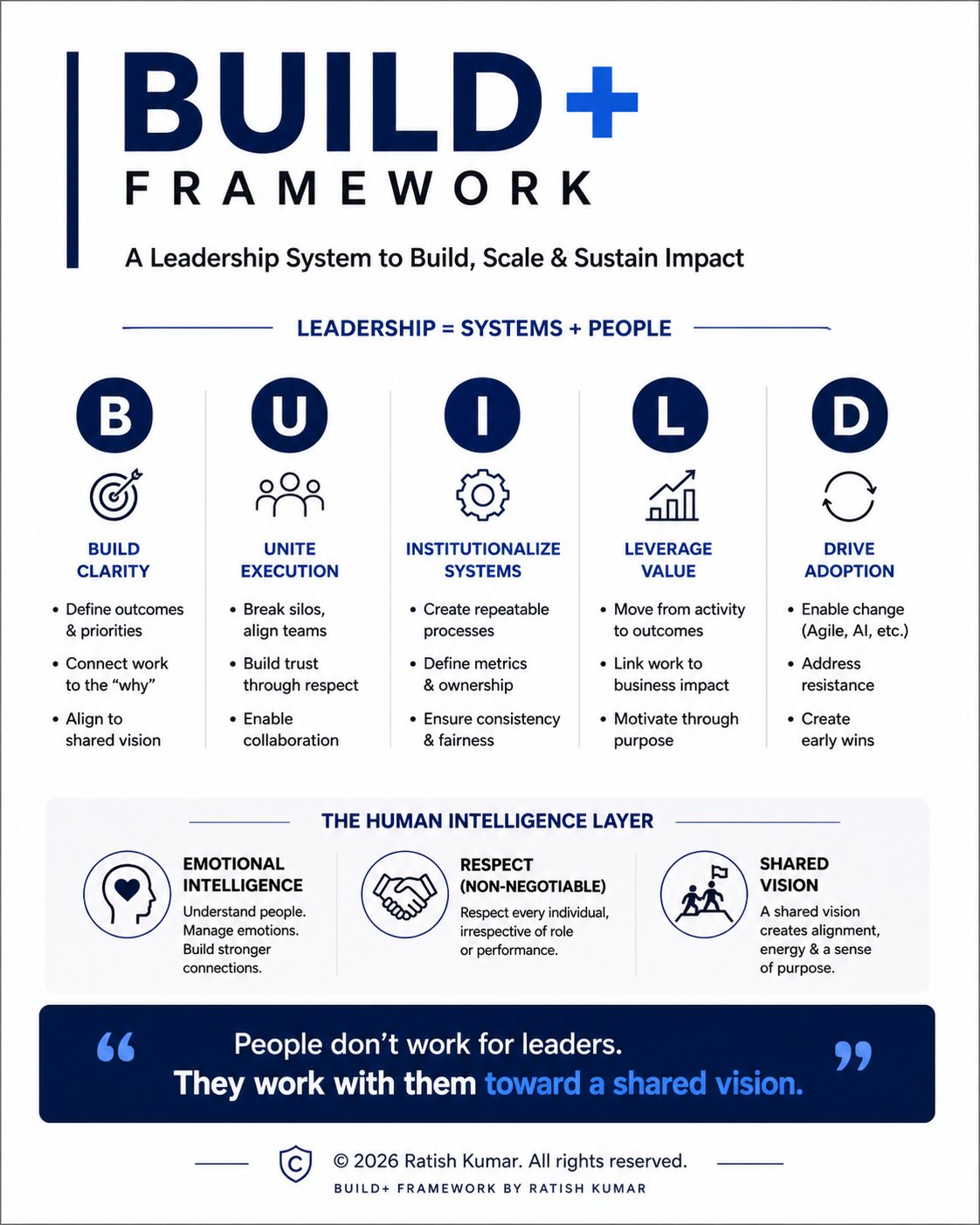
The BUILD+ Leadership Framework diagram showing five structural pillars (Build Clarity, Unite Execution, Institutionalize Systems, Leverage Value, Drive Adoption) and a Human Intelligence Layer (Emotional Intelligence, Respect, Shared Vision)
The BUILD+ Framework — the system the book develops.

The book is currently in manuscript and being prepared for publication. To be notified when it is available, please get in touch.

Working paper Essay on governance

Signatory Leadership

Why AI Accountability Belongs to an Office, Not a Person

In February 2024, a Canadian tribunal told Air Canada to honour a refund policy its chatbot had invented. The case was small. It also exposed a question boards are about to face at much larger scale: when an AI system speaks or acts on the organisation's behalf, who, by name, is the human responsible?

Most organisations are answering that question by naming a senior individual. That answer is reasonable. It is also incomplete. As AI systems start to outlast the executives who approved them, individual accountability begins to strain, and a different kind of accountability becomes necessary: one that belongs to an office, not only to a person.

This paper proposes a governance design called Signatory Leadership — defined not as a named person carrying personal accountability for an AI system, but as a permanent organisational office, held by a named individual at any given time but transferring intact across individuals. The piece draws on parallels with the Reserve Bank Governor, the US Federal Reserve Chair, the UK Lord Chancellor, and the UN Secretary-General — institutional offices whose continuity already operates this way — and shows what it would mean to extend that infrastructure into the longer, less stable lifecycle of AI systems.

The argument distinguishes three things current AI accountability conversations blur together: personal liability, institutional continuity, and formal delegation. It then shows what changes in practice when the signatory is treated as an office: handover becomes formal re-attestation, duties become institutional standards, and accountability stops evaporating at every leadership change.

The paper is currently in working-paper form and being prepared for publication. Full text is available on request to researchers, board members, and practitioners working in AI governance.

Disclosure: The author coined the term Signatory Leadership. He discloses the use of AI tools during research and drafting; all argumentative claims remain his own.

About

Twenty years of leadership, across very different organizational stages.

I am currently Associate Director at PracticeSuite, a US-based healthcare technology company, where I lead the Mumbai delivery organization serving the firm's American healthcare clients. I joined in 2020 and have spent the last six years building the India office from the ground up — from zero employees to a team of more than sixty.

Before that, I spent seven years as co-founder of an IT transformation firm focused on e-governance projects across multiple Indian states and cities. Before that, senior delivery and program leadership roles in mid-sized technology organizations. And before all of it, I started my career at one of India's largest IT services companies, working on enterprise banking solutions for global clients.

What that range gives me is a perspective most leadership writers do not have. I have been the early-career engineer working under leaders. I have been the co-founder building a company from scratch. I have been the senior manager running large delivery programs. I am now running an enterprise office for a healthcare-technology firm. Different sectors, different stages, different sizes — and across all of them, the same set of patterns that decide whether new leaders will struggle or thrive in their first three years.

That accumulated observation is what the book is about. The governance paper, in a different way, is the same instinct applied to a different problem — the question of how organizations should design accountability when the systems they are accountable for now outlast the people who approved them.

I write from Mumbai, where I live and work.

Engagements

Where the work continues, beyond the writing.

The book and the paper are the long-form parts of what I do. The shorter-form work happens in conversation with the leaders and organizations who reach out. A few of the forms that takes:

Contact

Get in touch.

For speaking, advisory, or research conversations — or to be notified when the book is published — please reach out. I read everything that comes in, and respond as quickly as the work allows.